The General Selects the Evacuation List
The SympathizerThe General Selects the Evacuation List is the act of deciding who will be evacuated as the regime nears collapse. Although The General entrusts the task to The unnamed narrator, the list becomes the narrator’s burden: each name offers a chance of survival to one person while excluding others, including senior officers and a prisoner he has already failed to rescue.
Delegation and the pressure of the moment
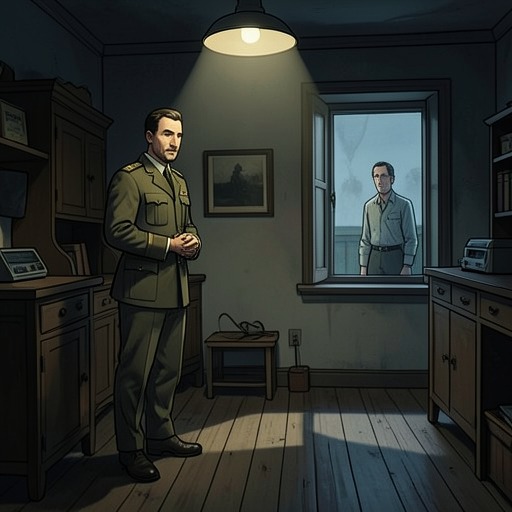
The president’s resignation does little to interrupt The unnamed narrator’s work. The General is occupied with interrogation reports, meetings at the Joint General Staff compound, and calls with confidants trying to hold the city while preparing to abandon it. He leaves the evacuation list to the narrator, who works through it at night at the villa. American songs play on a Sony radio, but music that ordinarily made bad things bearable cannot soften the significance of crossing out a name. Each stroke feels like a death sentence.
The selection takes place amid mounting signs that escape is becoming urgent. While the narrator works and revises the list over several days, the defenders of Xuan Loc are annihilated and Phnom Penh falls to the Khmer Rouge. The former president secretly leaves for Taiwan a few nights later. Claude, who drives him to the airport, reports that the president’s unusually heavy suitcases clanked with something metallic, presumably gold. The next morning, Claude tells the narrator that their plane will leave in two days, giving the list a firm deadline.
The prisoner behind the choices
The narrator’s decisions are shadowed by The Communist Agent, whose file remains on his desk. Three years earlier, the narrator had helped seize a list from her mouth when officers broke down her door; the names on it included everyone from the lowest-ranking officer to The General. The narrator knew she was on his side but could not safely reveal his own allegiance without risking his cover. She hated him for what she believed he represented, and pleaded that she was innocent as officers restrained her.
The narrator has not forgotten what followed. The Communist Agent is still imprisoned three years after her arrest. Her folder holds a photograph from the time of her capture and another taken months before: she was twenty-two when arrested, and the later image shows faded eyes and thinning hair. The narrator keeps the file as a reminder of his failure to save her. Man has also accepted responsibility, saying that he will unlock her cell when liberation comes. The prison photographs, with their record of time passing in confinement, inform the narrator’s sense of what it means to select a few people for salvation while condemning many others to be left behind.
A representative list and its exclusions
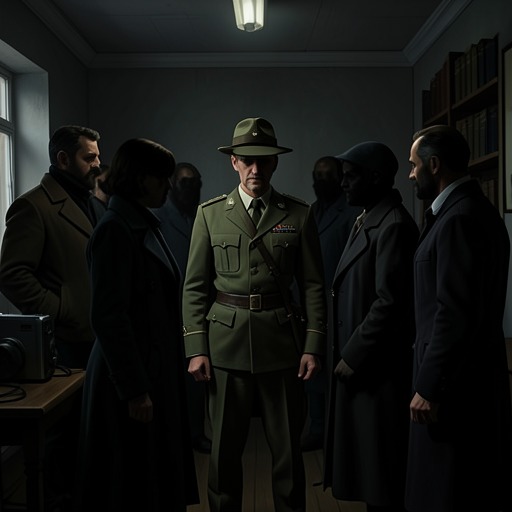
The narrator finishes the list early one evening and explains his method to The General as democratic and representative. He chooses a colonel, a major, another captain, and two lieutenants: the highest-ranking officer, the officer generally considered the most honest, the one whose company he likes best, and others chosen by similar considerations. The General accepts the reasoning and its consequence. Many senior officers, including men with extensive knowledge of and responsibility for the Special Branch’s work, will remain behind.
The list’s language of representation cannot make its exclusions fair or painless. It turns qualities such as rank, reputation, and personal affection into criteria for allocating a scarce passage out. The narrator presents the method as a way to distribute places rather than simply fill the plane with favored associates, but the choice still requires him to decide whose claims count. His own familiarity with the Special Branch’s methods, and the unresolved case of The Communist Agent, make the list more than a logistical exercise.
Bon’s place on the list
The narrator reserves one place for himself and three for Bon, Bon’s wife Linh, and their child Duc, the narrator’s godson. That decision is rooted in a bond formed before the war: Bon is one of the narrator’s two blood brothers, along with Man. The three sealed their loyalty as schoolboys by cutting their palms and mingling their blood in handshakes. The narrator carries a black-and-white photograph of Bon and his family, a private counterweight to the official list.
That night, The General visits with a half-empty bottle of whiskey. The narrator asks him to let Bon come. The General agrees, calling it the least he could do and noting that Bon is Airborne. His wistful claim that an army made up entirely of Airborne men would have won the war turns the favor into an acknowledgment of the military loyalty and loss surrounding the choice. In the villa courtyard, The General’s orderly feeds secrets into a fire in a fifty-five-gallon drum while gunfire occasionally breaks the hush. The list is thus made in the presence of both deliberate forgetting and immediate danger: it secures a narrow path out, but cannot rescue everyone whose name or history weighs on those who remain.